Showing posts with label OU. Show all posts

Wednesday, 5 June 2013

OU/RCN competition£5000 course fees for nursing/healthcare CPD

If you're training for a career in Nursing/healthcae - hi competition may be worh entering...

Win Open University modules worth up to £5,000 to support your professional development in nursing and healthcare
http://www.open.ac.uk/platform/news-and-features/win-open-university-modules-worth-%C2%A35000-support-your-professional-development-in-n?LKCAMPAIGN=pf1306&MEDIA=pf1306stu_gen_103
Working in partnership with the Royal College of Nursing, the OU is offering an opportunity for nurses and healthcare support staff to win sponsorship for OU study up to the value of £5,000. 

Funding will enable the competition winner to study part-time towards an OU qualification in nursing or healthcare or individual modules for continuing professional development.

Who can enter?Anyone who is a registered nurse or member of healthcare support staff working in the UK can enter:
  • Healthcare support workers/healthcare assistants
  • Registered nurses
  • Senior practitioners, healthcare leaders and managers
What's the prize?
The prize is 120 credits of fully funded undergraduate or postgraduate study with the OU in England (equivalent to one year’s full-time study) and will fund more than 120 credits of study if the winner is based in Northern Ireland, Scotland or Wales. The winner can study their chosen course part-time, flexibly over two years – studying with the OU means you won’t have to give up your current role or take significant time out of work.
Find out full details and how to enter.  Closing date for entries is Friday 5th July 2013


Monday, 15 April 2013

Happy 306th Birthday Euler!

Leonhard Euler was a pioneering Swiss mathematician and physicist. He made important discoveries in fields as diverse as infinitesimal calculus and graph theory.
And very prevalent in the MT365 OU course....

Wednesday, 28 November 2012

Tomorrow's Mathematicians Today 2013

Courtesy of the Open University:
 
Tomorrow's Mathematicians Today 2013
The IMA and University of Geenwich are organising a conference 'Tomorrow's Mathematician's Today 2013' on Saturday 16 February  at which undergraduates will be able to give short presentations about mathematics which excites them. For further information, go to http://mathsoc.cms.gre.ac.uk/tmt/

Wednesday, 19 September 2012

Wolfson OpenScience Laboratory - a promising online resource

From the Institute of Physics (@PhysicsNews) Classroom Physics newsletter :-

Online access to practical science with Wolfson lab
The traditional physics practical may have
had an occasional electronic facelift but
it has not changed much in decades. The
appearance is still of wooden benches,
wires and springs, for instance — very much
a hands-on environment.
Physics in professional laboratories is
different. Many physicists have no direct
physical connection with their experiments.
Actuators drive instruments and data
arrive through a computer linked to central
facilities such as CERN and satellites.
Conversations are with colleagues across
the world. It is an online environment.
The Open University has been awarded £1 m by the Wolfson Foundation to
reflect this change in practical science in its teaching. The Wolfson OpenScience
Laboratory will provide online access to practical science, not only to Open
University students but also to students across the globe. All science subjects will be
covered and many of the experiments will be relevant to schools.
The laboratory will include remote access to real laboratories and
observatories, for example optical and radio telescopes; virtual instruments such
as gamma-scattering apparatus with real data accessed interactively; immersive
3D field investigations with digitised real landscapes; and access to citizen science,
including “Treezilla”, a massive tree survey. The Open University will be collaborating
with other universities, schools and professional bodies and the priority will be
to improve access in developing countries For more information: visit www.open.
ac.uk/blogs/openscience

This includes the utterly brill Virtual Microscope - a web microscope (see screenshot above) with a selection of Histology & Pathology specimens to look at. The controls let you focus the microscope and take pictures.


Friday, 20 January 2012

Review of Stargazing (pt3)

Another good programme - Concepts covered in the final part were:
The extent of the Solar system (Kuiper belt & Oort cloud) and how we can detect objects that far out.

The search for Exo-planets and techniques used and the possibility that the TV audience had helped to find one amongst Kepler's telescope data.
We had Prof. Cox enplaning Astronomical Units  (AUs) using sugar lumps in a tea room (You need to see with your own eyes...).
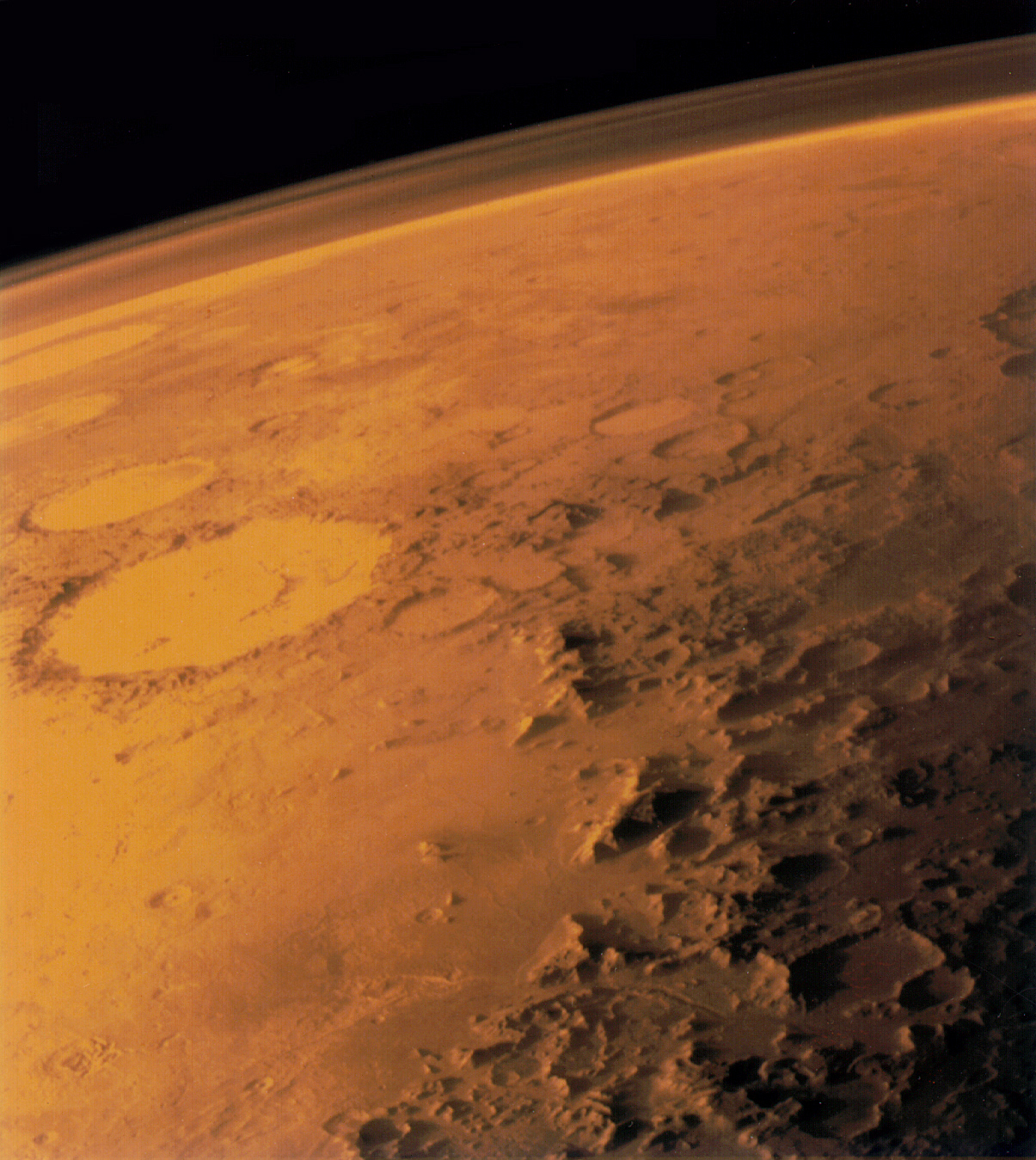
Mars & it's atmosphere (NASA)
We also saw the programme succeed in the conversion of a light polluted village into a dark village (the effect was somewhat spoilt by typical British weather meaning that the stars were not visible...)
High Atlas, Morocco
Also covered was the search for life  "out there". As far as the Solar system is concerned we can probably only expect microbes ( Indeed, some people have hopes about the recent Mars meteorites in Morocco).
If we go farther out, maybe there will be intelligent lifeforms. Mention was made of the Seti project  and we had a brief snippet from David Brin (The SciFi Author of The Postman) warning about how first contact could go wrong.
This episode (and others) is viewable at the Stargazing web-site plus there are lots of resources (some from the OU) for Teachers, pupils and parents.

Wednesday, 18 January 2012

Review of Stargazing (ep 2)

The second programme covers even more ground than the first.
Andromeda Galaxy (Source: NASA)
We had demonstrations of how galaxies collide to form new ones; how we can detect black holes; a computer simulation of the formation of galaxies from the Big Bang with a discussion about Dark matter.

Once again we had time devoted to amateur astronomers and the weighty topic of light pollution reducing what we can see of the night sky.

There was a delightful example of an outreach activity in South Africa where children were enticed into looking up into the sky by simply flying kites and as dark descended they were accompanied by an astronomer talking to them about galaxies.

There was even a section discussing UFOs and explanations of what people had really seen (But no Mulder & Scully sadly).

Two episodes down and one to go...

Tuesday, 17 January 2012

Review of Stargazing (ep 1)

First part of three (viewable at Stargazing web-site) and pretty good viewing.
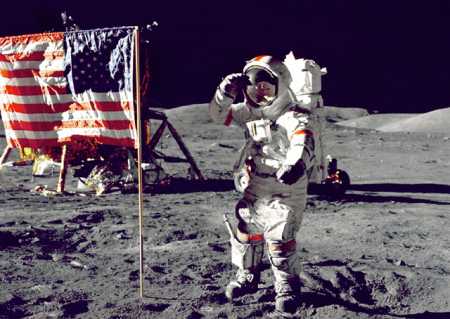
Quite a good proportion on the moon and interview with Eugene Cernan, who was both the LEM (Snoopy) pilot on Apollo 10 and the Commander of Apollo 17 (last man on the moon). Quite an interesting and forthright chap.


Prof Cox gave a good explanation about why tides occur and then showed that not just water was affected by gravitational tides.
Another highlight was segments on the role of telescopes based in South Africa and their view of the universe from the Southern Hemisphere.
Another section focused in on amateur astronomers and gave advice on equipment ranging from the naked eye to computerised telescopes.
Another highlight was at the end with the TV audience being invited to crowd-source in the effort to find exo-planets using data from the Kepler space telescope.

Friday, 13 January 2012

Stargazing LIVE interaction using Twitter

Something from my OU mailbox that mey be of interest to Physics pupils and teachers:-

Stargazing LIVE: Get involved


Stargazing LIVE returns for a second series on 16th, 17th and 18th January and this time, it’s an OU / BBC co-production with OU academics from the Department of Physical Sciences involved. Broadcasting live from the control room of the Jodrell Bank radio observatory in Cheshire, the show will be presented by Professor Brian Cox and Dara O Briain with Liz Bonnin reporting from South Africa.

As the show airs, you can get involved on Twitter if you have an account by tweeting using the #bbcstargazing hashtag. Also visit OpenLearn at
http://www.open.edu/openlearn/stargazing and enjoy a series of interactives including the Virtual Planisphere which allows you to track the night skies throughout the year and the Virtual Microscope which gives you the chance to examine moon rocks and meteorites up close.

To find out more, visit:
http://www.open.edu/openlearn/stargazing

Monday, 5 December 2011

Another OU module finished...

Just got results in for my M208 Pure Mathematics module - passed it! This was despite my exam experiences (I found it to be a somewhat brutal paper). Have registered for next module MST209 Mathematical methods and models which is more applied (I don't think I'm really a pure mathematician at heart)...

Monday, 3 October 2011

British Society for the History of Mathematics Essay competition

BSHM Undergraduate Essay Prize

The British Society for the History of Mathematics is pleased to invite submissions for its 2011-12 undergraduate essay prize. The essay, which may be on any topic within the history of mathematics, should be between 2000-2500 words. The prize is open to any person who is enrolled as an undergraduate in a UK or Irish university during the academic year 2011-12. The value of the prize will be £100, plus one year free membership of the Society.
Essays in submission for the prize should be sent via e mail attachment to Dr Mark McCartney at m.mccartney@ulster.ac.uk.
Applicants should also give details of their place and year of study and the title of the degree programme on which they are enrolled.
The deadline for receipt of submissions is 1st May 2012

A poster is available - please print and display this if you are in a position to advertise this Prize to undergraduates.

Thursday, 11 August 2011

Third and last episode of "The Code"

Interesting final programme which covered a lot of ground but seemed slower than the other two episodes. It focused upon mathematical prediction and started with Christopher Columbus gaining much needed supplies from unfriendly (and superstitious) natives by using tables that predicted eclipses.
Next Marcus avoided a 30Kg steel "ball of death" by predicting it's trajectory and landing point. He then pointed that the real world seems more random and less well-defined. Which moved us onto the flight behaviour of swarms of migrating starlings in Denmark which were able to be mathematically modelled using only a few parameters (For more info on how this complex behaviour can be modelled with simple rules search on "Agent based Models". I can recommend a free program called Netlogo and it's models of swarms).
This kind of software can be used to model all sorts of scenarios including competition within bacterial populations or (as a an example of a complex model) contamination events on food-production lines.
The next question was could this be extended to human behaviour and we are shown that it can be e.g. in modelling evacuation of buildings to design safer and more efficient ones).
The point was made that humans tend to behave in patterns with examples of the Rock, Paper, Scissors game and how detectives can use this kind of mathematics to track serial killers (This formed the basis of the pilot episode of the hit TV-drama series Numb3rs). Games like RPS can lead you to examples like non-transitive dice games which can also be described by the mathematical areas of Group Theory and Game Theory (see http://www.ansible.co.uk/misc/mgardner.html).

Marcus then debunked the urban legend of Lemmings mass suicides and showed using a simple equation that described population growth with the two key properties of current population and growth rate. Lemmings have an unusually high population growth rate that causes dramatic "boom-bust" behaviour which is chaotic rather than random. Again, if you are interested in this area (mathematical modelling of populations, predator-prey etc)  I can recommend another piece of free software called Populus.
Chaos then led us to a famous British obsession - the weather. M du S quickly showed how chaotic behaviour limited weather prediction to short-term effects.

We then switched to the "Wisdom of the Crowds" and briefly mentioned Galton's Ox before moving on to the more popularist "How many jelly-beans in the jar" problem (See an extremely good example here on YouTube featuring Professor David Speigelhalter). The take home message was that when large numbers of opinions were solicited, then the over-estimators compensated for the under-estimators by cancelling out the errors. This wisdom of the crowds lead us to Google who explored using people's searches and relating them to real world trends such as forthcoming influenza epidemics. Twitter mining was also mentioned relating negative words amongst traders to the behaviour of the stock market.

The episode (and series) ended on an almost-incongruous idea that related  the doubling of a cities size resulting in a 15% increase in other socio-economic factors (e.g. salaries). The idea matched well with Andrew Marrs series on Mega-cities but I found it to be a weak ending to an otherwise excellent math & science communication programme.

Thursday, 4 August 2011

The Code (Episode 2) - a quick review

The Code, this week, focussed upon geometry and Symmetry (A topic that I've been immersed in recently in the Group Theory section of my OU Maths course).
In a one-hour breakneck speed journey it covered how the shapes in honeycombs, the Giant's Causeway, salt crystals and soap bubbles can be explained by mathematics. It also linked the works of Jackson Pollock and the mathematics of fractal patterns (Benoit Mandlebrot) and the animation techniques used by Pixar studios
to model real world objects like mountains, trees and waterfalls.
The latter was a good example of how maths is a bit of a two headed beast that flips almost seamlessly from the algebraic to the geometric and back again.


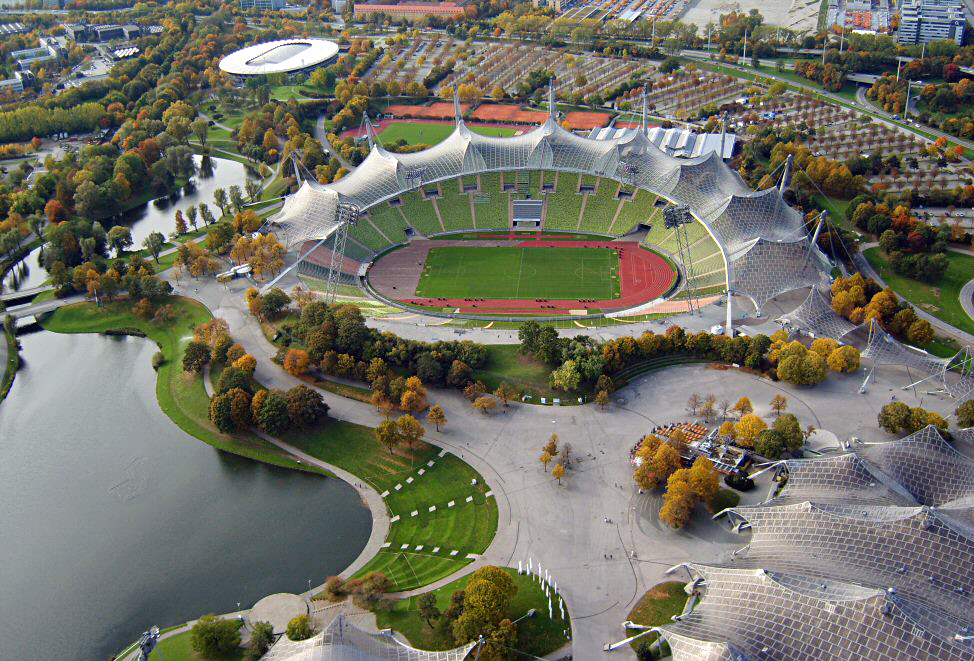
The bubble example was also used later on to explain how engineers designed the curved roofs of the Olympiastadion in Munich in the 70s without the advantage of modern day computing power using soap bubbles and strings (and, of course, maths!).


On a personal level, I think that this was a better episode than the first. I especially liked how the transition to the example of X-ray Crystallography showing how the structure of crystals relates to the arrangement at the atomic level. We also saw a virus particles icosahedron structure (A Platonic solid - introduced earlier in the programme using dice that would be familiar to any Dungeon & Dragons roleplayer) again with the goal of efficiency driving the shape of natural objects.

Next week's show is about Prediction. The Codes web-site has the following summary: "Professor du Sautoy's odyssey starts with the lunar eclipse - once thought supernatural, now routinely predicted through the power of the code. But more intriguing is what the code can say about our future.
Along the path to enlightenment, Marcus overturns the lemming's suicidal reputation, avoids being crushed to death, reveals how to catch a serial killer and discovers that the answer to life the universe and everything isn't 42 after all - it's 1.15.".

Thursday, 28 July 2011

A quick review of 'The Code'

Watched this last night. Overall, I thought that it was well-presented.  Marcus du Sautoy was a very good presenter (Although, I keep thinking that he looks a bit like the last incarnation of the Master from Dr Who...).
Within one hour we had covered prime numbers, Pi (and irrational numbers), exponential growth (e) and imaginary numbers ( i ).
The latter, in my opinion, was the weakest part as the importance of this concept was couched in the example that without imaginary numbers radar would be unusable and quickly moved on ( I guess it would have taken too long to show fourier analysis within the length of the programme).
I also got a bit annoyed at the slightly 'mystic' interludes that recapped concepts. They felt a bit like commercial breaks (Which the BBC do not have - maybe it's in preparation to sell to the US?).

I've seem some online criticism that says that the programme is too superficial. However, this series is about public understanding of mathematics not an OU lecture on Mathematics. These are two distinct goals.
I think that it will encourage people to see and appreciate the mathematics in the real world. Many people will have , for example, listened and enjoyed a piece of music without considering that an explanation of why it is pleasant to listen to is achievable by use of mathematics and understanding ratios.

So, I feel that the series is off to a good start and I am eagerly awaiting the next episode...
Link to programme web-site and to BBC Iplayer
I was reminded by this episode how much I am fascinated by Euler's identity and how it binds most of the above concepts into a deceptively simple equation:

Tuesday, 26 July 2011

BBC Programme on Maths in the Natural world

Looks to be a promising programme on real-life relevance of Mathematics.
The Code is a new BBC television series produced in conjunction with the Open University which starts on Wednesday 27th July, 9pm on BBC Two http://www.bbc.co.uk/tv/features/code/.
The Code is a three-part TV series about maths in the natural world, presented by Marcus du Sautoy. Why do bees make hexagonal honeycomb? Where's the best place to stand to get on a train first? How can dozens of wrong answers make a correct one? Join Marcus on an exciting journey to discover how maths shapes the world around us.
Marcus du Sautoy OBE is the Simonyi Professor for the Public Understanding of Science and a Professor of Mathematics at the University of Oxford, who also worked on the TV programs associated with the OU's The story of maths module http://www3.open.ac.uk/study/undergraduate/course/tm190.htm.

Thursday, 7 April 2011

Free Genome Fridge Magnets

Serendipitous discovery - The Open University are giving away free sets of genome fridge magnets.
You get a set of human chromosomes (including 2 X and 1 Y) and this can be useful in all sorts of educational activities e.g. pairing up the chromosomes and noting differing lengths and the position of centromeres and the role of the chromomes in determining sex. Order them from here:
Excellent for parents and educators aike.

Tuesday, 15 February 2011

New year, new challenges

Have started a new OU Maths course unit (Pure Mathematics M208) having got my OU Certificate in Mathematics last year.

The bad weather meant that I was unable to do the school visit last year - I'm disappointed, but am hoping to reschedule in the near future.

Hopefully, I will be helping out at "Science in Norwich Day" (19th March 9:30am-4pm at the Forum).
The event billing is "Family science discovery day; hands on activities, exhibitions, displays and shows for all ages".

Thursday, 18 November 2010

Mathematical Challenges for Biologists

I attended this event on Tuesday at Reading University. Organised by the UK Centre for Bioscience and BBSRC, it was well attended (~40 people) and discussions centred upon the fact that some candidates starting a Biology degree encounter problems with mathematical concepts that are essential to biology (e.g. calculating how to make up Molar solutions or in the use of logs in calculating pH) i.e. 'toolkit' skills.
Additionally, awareness needed improving that candidates hoping to progress into areas like Systems Biology or Mathematical modelling need even more advanced maths skills.
Actions suggested include communicating better to prospective candidates of the advantages of having AS or A2 Maths and remedial course modules targetting the deficiencies where they exist.

I learnt quite a bit about the areas of maths that e.g. GCSE holders have covered (depending upon grade in Foundation or Higher) which may well be useful when designing outreach activities for STEm activities.

Extremely productive day and hopefully it will improve the Biology degree experience for undergraduates.
(I have a great deal of sympathy as in my day,I did all 3 sciences at A-level and only O-level Maths and had to work hard to catch up and still am via the OU. With the way in which Biology has changed the need for mathematical skills has grown).

Monday, 25 October 2010

Back to 'normal'

Did exam for OU course MS221 last week (sat at small school desk) so that draws a close on that course unit (Think that I did alright but will have to wait until end of Dec for results :-(). All being well I will then have an OU Certificate of Mathematics.
Thinking that next module (in January) will be M208 - Pure maths (Yes my sanity may be questioned...) to be followed by MST209 - Mathematical Modelling. This, assuming I survive it will get me a Diploma in Mathematics.
I hope to then do some further modules to get a Diploma in Statistics with a (long-term) goal of a BSc in Mathematics and Statistics to add to my BSc Biological Sciences and Graduate Diploma in Systems Design.

Wednesday, 7 April 2010

Another visitor & more OU

We have another visiting scientist - Zhao Xiaoyan (Cindy) is from China and working with Pradeep for a month.
I had to get her laptop MAC address so she could get access to our wireless network. I'm getting good at deciphering non-english IPCONFIG reports (Dutch, Catalan and now Chinese :-)).

Delivered the latest OU Maths TMA to my tutor (for MS221) yesterday - probably not as good as I could do but at least it is done and delivered. Need to crack on wth last unit (D) of MST121 and start next unit(B) of MS221 - no rest for the wicked!

Tuesday, 9 March 2010

Keeping busy...

I'm finishing off a scientific conference poster for some work on the EU biotracer project and preparing some material for schools visits as part of Countdown 439 - two very different audiences. Plus I'm working hard on my OU Maths course...