Adventures in coding Science

Showing posts with label Science Club. Show all posts

Friday, 4 September 2015

This years RI Christmas Lectures are on human health in space!

More information here.

The 2015 CHRISTMAS LECTURES

How to survive in space

image
We are excited to announce that this year’s Christmas Lecturer is Dr Kevin Fong, an emergency doctor and expert in space medicine, who will present the three part CHRISTMAS LECTURES series 'How to survive in space' on BBC Four this festive season.

In celebration of British astronaut Tim Peake's upcoming mission to the International Space Station (ISS), this year's Lectures will shine a spotlight on international achievements in space science and engineering.

Kevin and the ISS astronauts will open a window onto today’s most exciting space missions, explore the future of space travel and offer a unique insight into the challenges of protecting human life in the hostile environment of space.
Print Friendly and PDF
Posted by Mark Fernandes at 09:24 0 comments
Email ThisBlogThis!Share to XShare to FacebookShare to Pinterest
Labels: Astronomy, biology, Food technology, microbiology, schools, Science Club

Thursday, 26 March 2015

London event
Pop-Up Screens <http://www.popupscreens.co.uk/> is a mobile cinema that
does a lot of open-air cinema screenings in Summer and other events in
indoor locations at less warm times of the year. They are doing a series
of five films in May which lend themselves to a bit of science
commentary. All take place at Chelsea Town Hall on Fri, Sat or Sun 15-17 May,
1pm or 6.30pm, details below.

  * Alien with science commentary
    <http://www.popupscreens.co.uk/movies/alien-with-science-commentary/> -
    6.30pm, 15 May
  * Apollo 13 with science commentary
    <http://www.popupscreens.co.uk/movies/apollo-13-science-commentary/>
    - 1pm, 16 May
  * Back to the Future 2 with science commentary
    <http://www.popupscreens.co.uk/movies/back-to-the-future-2/> -
    6.30pm, 16 May
  * Shaun of the Dead with science commentary
    <http://www.popupscreens.co.uk/movies/shaun-dead-science-commentary/> -
    1pm, 17 May
  * Good Will Hunting with science commentary
    <http://www.popupscreens.co.uk/movies/good-will-hunting-maths-commentary/>
    - 6.30pm, 17 May
Print Friendly and PDF
Posted by Mark Fernandes at 09:22 0 comments
Email ThisBlogThis!Share to XShare to FacebookShare to Pinterest
Labels: biology, math, outreach, physics, Science Club, STEM

Monday, 23 March 2015

Of interest to Primary & Secondary Schools:

16th March 2015, 17:07 Astro-Pi in the maths classroom by Steve Lyon
In partnership with the United States, Russia, Japan and Canada, Europe is sharing in the greatest international project of all time - the International Space Station. The ISS has enough room for its crew of six persons and a vast array of scientific experiments. It’s a lab and a home… in space!
Tim Peake is due to go to the International Space Station in November 2015 and spend six months there carrying out scientific experiments. He will be the first British ESA astronaut to visit the Space Station.
A team of leading UK Space companies, Raspberry Pi and the UK Space Agency have joined forces with Tim to offer young people the chance to devise their own app or experiment. The best of these will be taken to the ISS as part of Tim's mission and run on the Raspberry Pi computers he’s taking with him.
So – what would YOU do with a tiny computer on-board the space-station, equipped with lots of sensors, inputs and outputs? Your ideas can win great prizes for your school, no programming necessary! And to help you get started, we’ve provided lots of ideas and background learning materials.
Secondary school students can win more prizes by coding their solution in Python. Lots of help is available, so don’t worry if you’ve never written any code!
To find out more, go to astro-pi.org but hurry – Tim’s training is almost complete and your idea must be ready to fly too!

The astro-pi competition is a great opportunity to bring the excitement of space travel to your subject. Teachers of science, maths, computing and more will find resources and ideas for the classroom, helping you enrich learning for all students and prepare teams for the competition.
Print Friendly and PDF
Posted by Mark Fernandes at 09:33 0 comments
Email ThisBlogThis!Share to XShare to FacebookShare to Pinterest
Labels: Astronomy, international projects, outreach, schools, Science Club, STEM

Monday, 11 August 2014

May be interest to teachers of year 12 physics students:-

I want to share with you the Weizmann UK Safe Cracking Physics Tournament, where teams of Year 12 students from across the UK have the opportunity to compete in a safe making and breaking competition.

Teams design and build safes which have locking mechanisms based on the principles of physics. They then put their safes to the test in a tournament of 'safe cracking'. They get to be creative, challenge their knowledge, see physics in action and have loads of fun!

I am still in awe of the brilliant ideas the teams had at the last tournament and can't wait to see the next lot of safes. You can see more by watching the following videos, which include safes which can only be opened by using potatoes, making a cup of tea or 'playing' table football! The videos are here: http://bit.ly/1scnPEP

Teams who win the UK tournament will receive a travel grant to cover flights and accommodation to enable them to represent the UK at the International Tournament at the Weizmann Institute of Science where they compete against teams from across the world.

Please can you forward this information to school students and teachers who you think may be interested in participating? Registration for the competition closes at the end of September 2014, and the UK tournament will be held on Sunday 8 February 2015.

Let me know if you have any questions about the competition.

Thank you,

Lydia Wood
Science Projects Coordinator
T. +44 (0)20 7424 6866
lydia@weizmann.org.uk
www.weizmann.org.uk

Registered charity no: 232666
Print Friendly and PDF
Posted by Mark Fernandes at 10:21 0 comments
Email ThisBlogThis!Share to XShare to FacebookShare to Pinterest
Labels: physics, schools, Science Club

Friday, 8 March 2013

Science & Plants for Schools Science teacher/technician grants

SAPS Associate Awards: Grants for science teachers and technicians

Awards | Award Holders | Applying for an Award | Application Forms


Science and Plants for Schools supports UK teachers, HLTAs and technicians with new ideas for teaching about science through plants.
We'll offer grants and funding of up to £500 to cover your time & costs in developing a teaching resource, and will offer support and scientific contacts if necessary.
We also offer grants of up to £100 to fund teacher and technician-led CPD, such as TeachMeets.
Proposed resources should aim to enhance students' understanding of plants at secondary and post-16, whether in a broad sense of fundamental principles, lab techniques (e.g. time-lapse photography), or a specific focus on an area of plant biology.
The deadline for grant applications for Spring 2013 is 29th March 2013.  The deadline for grant applications is 13th May 2013. 
Find out more about the award criteria , funding CPD opportunities, and about current award holders.
Print Friendly and PDF
Posted by Mark Fernandes at 16:30 0 comments
Email ThisBlogThis!Share to XShare to FacebookShare to Pinterest
Labels: schools, Science Club, STEM, UK

Friday, 16 November 2012

RI's #scienceclub animations available here

As the title says, the animations from BBCs Science Club programme are viewable from the Royal Institutions web-site here.
Inheritance and The History of Physics are up and others will doubtlessly be uploaded here as the series progresses.
Enjoy!
Print Friendly and PDF
Posted by Mark Fernandes at 12:07 0 comments
Email ThisBlogThis!Share to XShare to FacebookShare to Pinterest
Labels: Science Club, STEM, UK

Thursday, 15 November 2012

#scienceclub episode 2

OK, a quick review of the second episode. Please forgive any omissions as I didn't take notes and had my two young sons creating their own brand of mayhem in the room...
The show was themed on Einstein (The real one not the Yahoo Serious one). A brief animation of his work and the History of Physics was shown. We were brought into a conversation with Professor Jim Al-Khalili (Whose excellent Shock and Awe series on electricity is being repeated at the moment - recommended viewing) about 'nothing' or rather what does space consist of (so ideas like dark matter & dark energy and vacuum energy featured). The findings about how the universe is expanding even more rapidly that previously thought heading towards  a theoretical 'Big Rip'.
Experiments included measuring the speed of light using micro-waved cheese on toast and Mark M. did some fridge dis-assembly(!).
The funding of big science (e.g. applied physics) got a similar treatment to last episodes piece on the Human Genome project (i.e. can we afford to fund it, what practical use is it etc) and included a disappointing sound-bite from Sir David King implying that we should fund more practical science rather than 'Big Science'.
Finally, a consideration of the fate of Albert's brain after he died and what made it different from 'normal' brains occurred.
All in all, a good episode, but in my own personal view,not quite as good as the first episode (but then I'm a biologist :-)).
Next episode will have the theme of life, death & extinction (sounds cheerful!).

Print Friendly and PDF
Posted by Mark Fernandes at 14:05 0 comments
Email ThisBlogThis!Share to XShare to FacebookShare to Pinterest
Labels: math, physics, Science Club, STEM, UK

Wednesday, 7 November 2012

Review of #scienceclub

Watched the first episode of the BBC's new science series "Science Club" last night (it's viewable on Iplayer here and is broadcast on BBC2 on Tuesdays at 9pm).  The post programme web-chat is available here.

Dara O'Briain was the host with four additional presenters. This episode was themed on the science of Genetics and started with a brief gentle introduction to how our understanding has grown from the Greek era to modern day. There was then a discussion of how genetic diversity has increased due to ability to travel wider to find mates (starting with the bicycle and moving on to air travel).
This was followed by a brief appreciation of that ground-breaking invention - the bike.
There then was an investigation of the audiences parental diversity with some interesting results.
Another experiment tried blending the audiences faces to get an 'average' face that according to one theory should be more attractive as it lacks asymmetry. This was dismissed at the end of the programme when the resulting images were displayed...

Next there was a consideration on the number of genes in different organisms and similarities between species. A simple test using Boar scent illustrated that certain people had a gene that enabled them to smell it (either nice or nasty) which was reminiscent of the IFR Taste & Flavour activity.

It was followed up by a critical evaluation of the Human Genome project and illustrated the difficulty in explaining to non-scientist politicians why an area of science should be publicly funded.
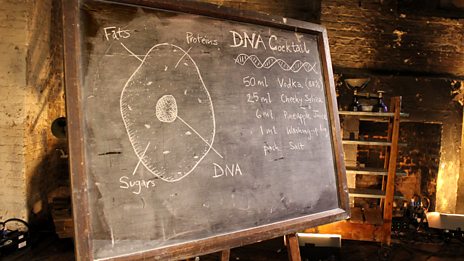
Next the team extracted human DNA from cheek cells using washing up liquid (fat dispersant), pineapple juice (protease) and 88% proof Polish vodka (With due deference to our Polish PhD student, Dara demonstrated that DNA extraction was a better use for this than drinking it :-)).


This was followed up by a report on how the sequencing of Neanderthal DNA illustrated that before they died out, there was some inter-breeding with homo sapiens.

The equivalent of the "Top Gear Cool wall" was displayed with pictures of scientists who have made significant contributions to genetics.

Another aspect of genetics was then explored - epi-genetics which illustrates that diet and lifestyle CAN affect expression of our genes. Results seemed to indicate that effects our diet & lifestyle could be passed on affecting even our grandchildren. Sadly, it stopped short of exploring our extended genome provided by the commensual bacteria in our gut (An area of interest to scientists at the Institute of Food Research).

To summarize, a very good and promising start at a very accessible general science programme.
Print Friendly and PDF
Posted by Mark Fernandes at 12:41 0 comments
Email ThisBlogThis!Share to XShare to FacebookShare to Pinterest
Labels: outreach, Science Club, STEM, taste and flavour, UK
Older Posts Home
Subscribe to: Posts (Atom)

My Blog

Mark Fernandes

Create Your Badge

Translate

Pages

  • Further Information

About Me

My photo
Mark Fernandes
I work at The CRUK Cambridge Institute. My original Degree was in Biological Sciences. I also have a Graduate Diploma in Systems Design and an OU Maths & Statistics Degree. In the area of Scientific outreach activities I am a STEMnet Ambassador and was a BBSRC Schools Regional Champion. I am currently involved in Bioinformatics training provision.
View my complete profile

Twitter

Tweets by @MAFatIFR

Follow me on Twitter

Follow @MAFatIFR

Popular Posts

  • New Year's post
    Back at work in a winter wonderland :-) Continuing normalising data for a Institute Strategic Programme Grant project SUSSLE. It is to creat...
  • Big Bang posting
    Did Big Bang Fair yesterday at Docklands. Lots of classes full of bright children getting their science fix. We were swamped at times! Jus...
  • School of Hard Sums - more reviews
    More reviews of the programme starring @ MarcusduSautoy & @ daraobriain. Sorry I'm getting behind with putting these reviews up. ...
  • Review of #scienceclub
    Watched the first episode of the BBC's new science series "Science Club" last night (it's viewable on Iplayer here and is...
  • Free Genome Fridge Magnets
    Serendipitous discovery - The Open University are giving away free sets of genome fridge magnets. You get a set of human chromosomes (inclu...

Blog Archive

  • ▼  2018 (2)
    • ▼  March (2)
      • Cambridge Science Festival
      • I'm back!
  • ►  2016 (5)
    • ►  October (1)
    • ►  June (1)
    • ►  March (1)
    • ►  February (1)
    • ►  January (1)
  • ►  2015 (16)
    • ►  November (1)
    • ►  October (3)
    • ►  September (2)
    • ►  August (1)
    • ►  May (2)
    • ►  April (1)
    • ►  March (3)
    • ►  February (2)
    • ►  January (1)
  • ►  2014 (17)
    • ►  August (4)
    • ►  May (4)
    • ►  April (2)
    • ►  March (1)
    • ►  February (1)
    • ►  January (5)
  • ►  2013 (31)
    • ►  December (1)
    • ►  November (4)
    • ►  October (2)
    • ►  September (4)
    • ►  July (1)
    • ►  June (4)
    • ►  April (3)
    • ►  March (7)
    • ►  February (2)
    • ►  January (3)
  • ►  2012 (123)
    • ►  December (4)
    • ►  November (11)
    • ►  October (4)
    • ►  September (21)
    • ►  August (24)
    • ►  July (14)
    • ►  June (7)
    • ►  May (7)
    • ►  April (3)
    • ►  March (11)
    • ►  February (5)
    • ►  January (12)
  • ►  2011 (41)
    • ►  December (3)
    • ►  November (10)
    • ►  October (8)
    • ►  September (5)
    • ►  August (5)
    • ►  July (3)
    • ►  June (1)
    • ►  April (1)
    • ►  March (4)
    • ►  February (1)
  • ►  2010 (15)
    • ►  November (2)
    • ►  October (3)
    • ►  July (3)
    • ►  April (2)
    • ►  March (4)
    • ►  January (1)
  • ►  2009 (1)
    • ►  December (1)

Labels

ASE (3) Astronomy (29) Big Bang (15) bioinformatics (2) biology (12) biotracer (7) chemistry (6) competition (7) crowd sourcing (5) datasets (2) Diversity (13) ecology (4) food security (14) Food technology (6) Food4Sport (5) funding (5) Google (1) Hard Sums (3) history (1) international projects (21) IT (3) jobs (1) math (47) messy church (4) microbiology (7) modelling (3) MSL (5) MySQL (2) netlogo (1) network (3) OU (20) outreach (143) physics (38) RCUK (2) schools (37) Science Club (8) scouting (1) sport (2) STEM (185) SUSSLE (3) sustainability (6) taste and flavour (9) UK (47) visitors (6) wiki (1)

Subscribe To

Posts
Atom
Posts
All Comments
Atom
All Comments

BlogUpp!

Food Poison Journal

Loading...

BBSRC Chief Executive's blog

Loading...

Food Standards Agency - Recent food alerts

Loading...

Institute of Food Research News Feed

Loading...

Understanding Uncertainty

Loading...

TweetMeme - Science

Loading...

Food security latest news

Loading...

Visitor map

free counters
Free counters

Visitor map (ClustrMap)

Simple theme. Powered by Blogger.