Just a brief post about an opportunity for early career scientists who are keen on public engagement activities :-
FameLab UK - The search is on for the new voices of science communication
The search is on for the new voices of science communication. The regional heats of FameLab UK will start in October 2011. We’d love it if you could help spread the word to drive entries. We've created some materials to help you do just that, including copy for your website and a Q&A for those who want to find out more. Please see http://famelab.org/uk/famelab-uk-2011/shout-out
FameLab was set up in 2004 by Cheltenham Science Festival in partnership with NESTA. In 2007 the competition was adopted by the British Council as one of its flagship science engagement projects first in a South East Europe pilot and then expanding this in 2010 to include 16 across Europe, Asia and Africa. In 2012, 20 countries will be taking part in the competition.
We’re looking to attract enthusiastic early career scientists to take part in order to identify a new generation of individuals who can engage the public. FameLab not only inspires the next generation of science communicators but excels at building the skills that will enable scientists and engineers to explain, debate, discuss and be challenged.
The competition is open to contestants over 21 years old and working in or studying science, technology, engineering, medicine or maths in the UK. Contestants have just 3 minutes to prove themselves to a panel of expert judges, with only the best going forward to the next round.
Heats are taking place in:
Newcastle, Centre for Life on 8 October 2011
Oxford, Science Oxford on 20 and 25 October 2011 (final on 17 November)
Cardiff, Chapter Arts Centre on 12 November 2011
Glasgow, Glasgow Science Centre on 19 November 2011
London, Kings College London on 23 and 30 November 2011 (final on 30 November)
Manchester, Museum of Science and Industry on 3 December 2011
Contestants who can’t attend one of the regional heats will also be able to submit their entries online.
The UK National Final will take place on 21 March 2012 at the Royal Institution of Great Britain.
Contestants taking part in the final will get the chance to take part in a weekend FameLab Master Class with Professor of Sciences and Society at Bristol University, Kathy Sykes, and experienced trainer, specialising in media & communication skills, Malcolm Love. The UK winner, chosen at the final, will win a place in the International Final and take home £1000 for themselves and up to £750 to spend on a science communication activity, whether it’s attending a conference, further training or developing a new event or activity.
If you want to find out more please visit www.famelab.org/uk.
Please get in touch if you have any questions (claire.rocks@cheltenhamfestivals.com)
Tuesday, 13 September 2011


Friday, 2 September 2011
Science Learning Centre course

 I've applied for a place on a Science Learning Centre course (NAC11151 : Connect 2011-2012 Professional Development for Scientists and Engineers - Science Communication for a School Teacher Audience) that looked interesting and useful from a Science Outreach perspective. It is supported by Research Councils UK (A partnership of the 7 Research Councils of which BBSRC is a member).
I may not get on it as the demand for places is always high. However nothing ventured, nothing gained...
Thursday, 11 August 2011
Promoting science to the next generation

Third and last episode of "The Code"
Interesting final programme which covered a lot of ground but seemed slower than the other two episodes. It focused upon mathematical prediction and started with Christopher Columbus gaining much needed supplies from unfriendly (and superstitious) natives by using tables that predicted eclipses.
Next Marcus avoided a 30Kg steel "ball of death" by predicting it's trajectory and landing point. He then pointed that the real world seems more random and less well-defined. Which moved us onto the flight behaviour of swarms of migrating starlings in Denmark which were able to be mathematically modelled using only a few parameters (For more info on how this complex behaviour can be modelled with simple rules search on "Agent based Models". I can recommend a free program called Netlogo and it's models of swarms).
This kind of software can be used to model all sorts of scenarios including competition within bacterial populations or (as a an example of a complex model) contamination events on food-production lines.
The next question was could this be extended to human behaviour and we are shown that it can be e.g. in modelling evacuation of buildings to design safer and more efficient ones).
 The point was made that humans tend to behave in patterns with examples of the Rock, Paper, Scissors game and how detectives can use this kind of mathematics to track serial killers (This formed the basis of the pilot episode of the hit TV-drama series Numb3rs). Games like RPS can lead you to examples like non-transitive dice games which can also be described by the mathematical areas of Group Theory and Game Theory (see http://www.ansible.co.uk/misc/mgardner.html).
Marcus then debunked the urban legend of Lemmings mass suicides and showed using a simple equation that described population growth with the two key properties of current population and growth rate. Lemmings have an unusually high population growth rate that causes dramatic "boom-bust" behaviour which is chaotic rather than random. Again, if you are interested in this area (mathematical modelling of populations, predator-prey etc) I can recommend another piece of free software called Populus.
Chaos then led us to a famous British obsession - the weather. M du S quickly showed how chaotic behaviour limited weather prediction to short-term effects.

We then switched to the "Wisdom of the Crowds" and briefly mentioned Galton's Ox before moving on to the more popularist "How many jelly-beans in the jar" problem (See an extremely good example here on YouTube featuring Professor David Speigelhalter). The take home message was that when large numbers of opinions were solicited, then the over-estimators compensated for the under-estimators by cancelling out the errors. This wisdom of the crowds lead us to Google who explored using people's searches and relating them to real world trends such as forthcoming influenza epidemics. Twitter mining was also mentioned relating negative words amongst traders to the behaviour of the stock market.
The episode (and series) ended on an almost-incongruous idea that related the doubling of a cities size resulting in a 15% increase in other socio-economic factors (e.g. salaries). The idea matched well with Andrew Marrs series on Mega-cities but I found it to be a weak ending to an otherwise excellent math & science communication programme.
Next Marcus avoided a 30Kg steel "ball of death" by predicting it's trajectory and landing point. He then pointed that the real world seems more random and less well-defined. Which moved us onto the flight behaviour of swarms of migrating starlings in Denmark which were able to be mathematically modelled using only a few parameters (For more info on how this complex behaviour can be modelled with simple rules search on "Agent based Models". I can recommend a free program called Netlogo and it's models of swarms).
This kind of software can be used to model all sorts of scenarios including competition within bacterial populations or (as a an example of a complex model) contamination events on food-production lines.
The next question was could this be extended to human behaviour and we are shown that it can be e.g. in modelling evacuation of buildings to design safer and more efficient ones).
 The point was made that humans tend to behave in patterns with examples of the Rock, Paper, Scissors game and how detectives can use this kind of mathematics to track serial killers (This formed the basis of the pilot episode of the hit TV-drama series Numb3rs). Games like RPS can lead you to examples like non-transitive dice games which can also be described by the mathematical areas of Group Theory and Game Theory (see http://www.ansible.co.uk/misc/mgardner.html).
Marcus then debunked the urban legend of Lemmings mass suicides and showed using a simple equation that described population growth with the two key properties of current population and growth rate. Lemmings have an unusually high population growth rate that causes dramatic "boom-bust" behaviour which is chaotic rather than random. Again, if you are interested in this area (mathematical modelling of populations, predator-prey etc) I can recommend another piece of free software called Populus.
Chaos then led us to a famous British obsession - the weather. M du S quickly showed how chaotic behaviour limited weather prediction to short-term effects.
We then switched to the "Wisdom of the Crowds" and briefly mentioned Galton's Ox before moving on to the more popularist "How many jelly-beans in the jar" problem (See an extremely good example here on YouTube featuring Professor David Speigelhalter). The take home message was that when large numbers of opinions were solicited, then the over-estimators compensated for the under-estimators by cancelling out the errors. This wisdom of the crowds lead us to Google who explored using people's searches and relating them to real world trends such as forthcoming influenza epidemics. Twitter mining was also mentioned relating negative words amongst traders to the behaviour of the stock market.
The episode (and series) ended on an almost-incongruous idea that related the doubling of a cities size resulting in a 15% increase in other socio-economic factors (e.g. salaries). The idea matched well with Andrew Marrs series on Mega-cities but I found it to be a weak ending to an otherwise excellent math & science communication programme.
Friday, 5 August 2011
Platonic Solids on Youtube
Found a nice video on Youtube on the Platonic solids. See "Platonic Solid Rock"
Thursday, 4 August 2011
The Code (Episode 2) - a quick review
The Code, this week, focussed upon geometry and Symmetry (A topic that I've been immersed in recently in the Group Theory section of my OU Maths course).
In a one-hour breakneck speed journey it covered how the shapes in honeycombs, the Giant's Causeway, salt crystals and soap bubbles can be explained by mathematics. It also linked the works of Jackson Pollock and the mathematics of fractal patterns (Benoit Mandlebrot) and the animation techniques used by Pixar studios
to model real world objects like mountains, trees and waterfalls.
The latter was a good example of how maths is a bit of a two headed beast that flips almost seamlessly from the algebraic to the geometric and back again.

The bubble example was also used later on to explain how engineers designed the curved roofs of the Olympiastadion in Munich in the 70s without the advantage of modern day computing power using soap bubbles and strings (and, of course, maths!).
On a personal level, I think that this was a better episode than the first. I especially liked how the transition to the example of X-ray Crystallography showing how the structure of crystals relates to the arrangement at the atomic level. We also saw a virus particles icosahedron structure (A Platonic solid - introduced earlier in the programme using dice that would be familiar to any Dungeon & Dragons roleplayer) again with the goal of efficiency driving the shape of natural objects.

Next week's show is about Prediction. The Codes web-site has the following summary: "Professor du Sautoy's odyssey starts with the lunar eclipse - once thought supernatural, now routinely predicted through the power of the code. But more intriguing is what the code can say about our future.
Along the path to enlightenment, Marcus overturns the lemming's suicidal reputation, avoids being crushed to death, reveals how to catch a serial killer and discovers that the answer to life the universe and everything isn't 42 after all - it's 1.15.".
In a one-hour breakneck speed journey it covered how the shapes in honeycombs, the Giant's Causeway, salt crystals and soap bubbles can be explained by mathematics. It also linked the works of Jackson Pollock and the mathematics of fractal patterns (Benoit Mandlebrot) and the animation techniques used by Pixar studios
to model real world objects like mountains, trees and waterfalls.
The latter was a good example of how maths is a bit of a two headed beast that flips almost seamlessly from the algebraic to the geometric and back again.
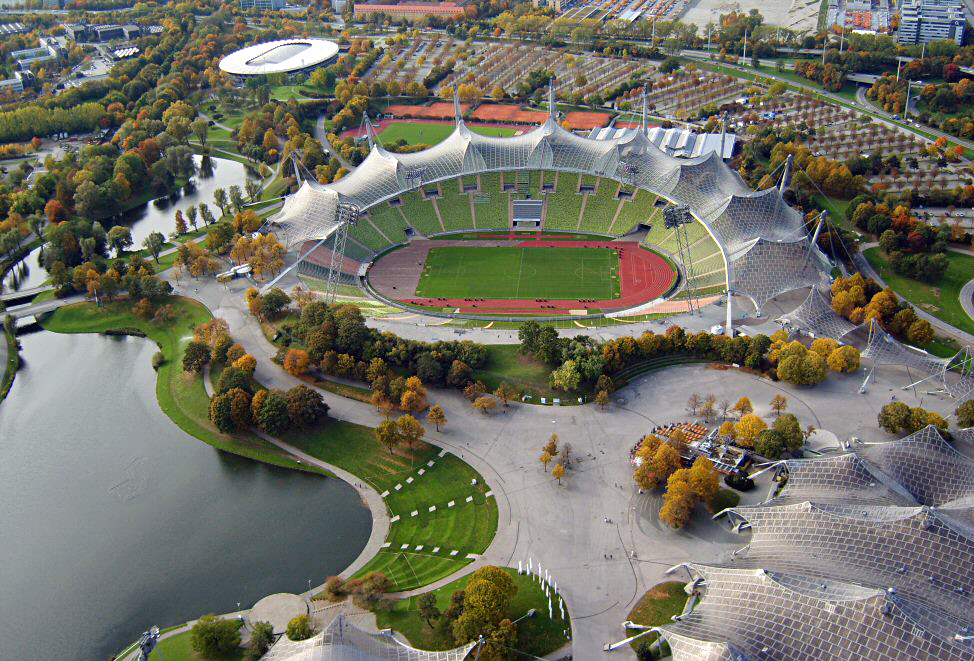
The bubble example was also used later on to explain how engineers designed the curved roofs of the Olympiastadion in Munich in the 70s without the advantage of modern day computing power using soap bubbles and strings (and, of course, maths!).
On a personal level, I think that this was a better episode than the first. I especially liked how the transition to the example of X-ray Crystallography showing how the structure of crystals relates to the arrangement at the atomic level. We also saw a virus particles icosahedron structure (A Platonic solid - introduced earlier in the programme using dice that would be familiar to any Dungeon & Dragons roleplayer) again with the goal of efficiency driving the shape of natural objects.

Next week's show is about Prediction. The Codes web-site has the following summary: "Professor du Sautoy's odyssey starts with the lunar eclipse - once thought supernatural, now routinely predicted through the power of the code. But more intriguing is what the code can say about our future.
Along the path to enlightenment, Marcus overturns the lemming's suicidal reputation, avoids being crushed to death, reveals how to catch a serial killer and discovers that the answer to life the universe and everything isn't 42 after all - it's 1.15.".
National Science & Engineering Competition at Big Bang Fair 2012
This may be of interest to Maths & Science High School classes and teachers:
The Big Bang Fair 2012
In 2012, The Big Bang will take place between the 15th and 17th March at The NEC, Birmingham. We will be welcoming school groups on the 15th and 16th and family groups on the 17th.
National Science & Engineering Competition
Do you know any 11-18 year olds who have completed a project in science, technology, engineering or maths? Did their project dazzle you? If so, you should encourage them to enter the National Science & Engineering Competition! Entry deadline is 31st October.
The Competition 2011-12
 Open to all 11-18 year olds living in the UK and in full-time education, the Competition rewards students who have achieved excellence in a STEM project.
The finals of the Competition are held each March as a central part of The Big Bang: UK Young Scientists and Engineers Fair. Teams and individuals compete in one of three age categories for a number of amazing prizes including cash sums, trophies, medals and trips abroad. The winners in the senior age category also gain the titles UK Young Scientist(s) of the Year and UK Young Engineer(s) of the Year.
For further information on specific parts of the Competition, please visit this link.
The Big Bang Fair 2012
In 2012, The Big Bang will take place between the 15th and 17th March at The NEC, Birmingham. We will be welcoming school groups on the 15th and 16th and family groups on the 17th.
National Science & Engineering Competition
Do you know any 11-18 year olds who have completed a project in science, technology, engineering or maths? Did their project dazzle you? If so, you should encourage them to enter the National Science & Engineering Competition! Entry deadline is 31st October.
The Competition 2011-12
The finals of the Competition are held each March as a central part of The Big Bang: UK Young Scientists and Engineers Fair. Teams and individuals compete in one of three age categories for a number of amazing prizes including cash sums, trophies, medals and trips abroad. The winners in the senior age category also gain the titles UK Young Scientist(s) of the Year and UK Young Engineer(s) of the Year.
For further information on specific parts of the Competition, please visit this link.
Subscribe to:
Posts (Atom)