Thursday, 27 September 2012

@ScienceGrrl Calendar 2013 - to encourage young women into science & engineering


For good role-model images of women in science and engineering careers, this might be a good resource:
 
ScienceGrrl is a network of (mostly) female scientists who are
passionate about passing on their love of science, technology,
engineering and mathematics (STEM) to the next generation
(www.sciencegrrl.co.uk, @Science_Grrl).

We're currently working on producing the ScienceGrrl Calendar 2013,
which celebrates the work of female scientists, and will be sold to our
peers, colleagues, friends and beyond. The proceeds will be invested in
projects that enable girls and young women to engage with STEM role
models, to encourage their aspirations and open their eyes to the range
of potential futures available to them within STEM. These projects
include "Breakthrough: the gender stereotypes project" and funded places
at the Mission Discovery summer school.

The calendar will feature 13 stunning images of female scientists from
a diverse range of backgrounds, showcasing a variety of science-related
careers. Three engineers on a London rooftop overlook a striking
cityscape, showing the structural impact of STEM all around us. A
medical physicist explains her work to a busy group of colleagues and a
patient in University of Manchester’s PETCT scanner. In Bristol, an
epidemiologist is surrounded by a blur of pedestrians as she examines
data for a link between cannabis-smoking and mental health. And there
are many more...

The calendar will be launched on 18 October 2012 and is available for
pre-order now:

Please share this information on Twitter, Facebook, Google+ and by any
other means with colleagues, friends and family and anyone else you
think would benefit from knowing more about ScienceGrrl.

Best wishes,

Lucy Harper
Press Manager
Science Grrl Calendar 2013

Monday, 24 September 2012

Free program (Windows/Mac/Linux) - Virtual Moon Atlas

For those interested in the Moon and planning telescopic examination of it, a free program is available form Virtual Moon Atlas

Thursday, 20 September 2012

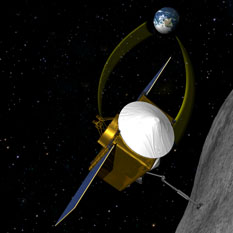
Name That Asteroid! (OSIRIS-REx Competition)

OSIRIS-REx mission NASA / Goddard / University of Arizona
 If you are a parent or teacher of a child (under 18) who is into
Space Science - this compo might very well hit the spot:
OSIRIS-REx is going to fly to an asteroid and bring back some pieces. Right now, the asteroid's name is 1999 RQ36, but we think students can do better!  The Planetary Society, MIT's Lincoln Laboratory, and the University of Arizona are asking students around the world to suggest better names for the asteroid.
Enter by December 2, 2012 to have a chance to name a piece of the solar system!
The contest is open to kids under the age of 18.  To enter, parents or teachers must fill out an online entry form with the proposed name and a short explanation of why that name is a good choice. 
Asteroids can't be named just anything, of course.  The International Astronomical Union governs the naming of big and small objects in the solar system, and they have guidelines on how to name near-Earth objects like 1999 RQ36.

http://planetary.org/get-involved/contests/osirisrex/ 

Wednesday, 19 September 2012

Wolfson OpenScience Laboratory - a promising online resource

From the Institute of Physics (@PhysicsNews) Classroom Physics newsletter :-

Online access to practical science with Wolfson lab
The traditional physics practical may have
had an occasional electronic facelift but
it has not changed much in decades. The
appearance is still of wooden benches,
wires and springs, for instance — very much
a hands-on environment.
Physics in professional laboratories is
different. Many physicists have no direct
physical connection with their experiments.
Actuators drive instruments and data
arrive through a computer linked to central
facilities such as CERN and satellites.
Conversations are with colleagues across
the world. It is an online environment.
The Open University has been awarded £1 m by the Wolfson Foundation to
reflect this change in practical science in its teaching. The Wolfson OpenScience
Laboratory will provide online access to practical science, not only to Open
University students but also to students across the globe. All science subjects will be
covered and many of the experiments will be relevant to schools.
The laboratory will include remote access to real laboratories and
observatories, for example optical and radio telescopes; virtual instruments such
as gamma-scattering apparatus with real data accessed interactively; immersive
3D field investigations with digitised real landscapes; and access to citizen science,
including “Treezilla”, a massive tree survey. The Open University will be collaborating
with other universities, schools and professional bodies and the priority will be
to improve access in developing countries For more information: visit www.open.
ac.uk/blogs/openscience

This includes the utterly brill Virtual Microscope - a web microscope (see screenshot above) with a selection of Histology & Pathology specimens to look at. The controls let you focus the microscope and take pictures.


Tuesday, 18 September 2012

FameLab UK 2013 Competition

A competition to celebrate science communicators & help them further develop their skills:
 
FameLab UK 2013
The search is on for the new voices of science communication. Over the autumn FameLab UK heats will be taking place across the country from Aberdeen to London, Cardiff to Cambridge. New for this year, and with help from the Royal Academy of Engineering, FameLab UK has also been able to produce two engineering specific heats to encourage more engineers to enter the competition and develop their skills.
If you're currently working in science. technology, engineering or maths, and think you can explain a science or engineering concept in an engaging way to non-scientists in just three minutes, FameLab wants to hear from you!
The winner of the heats will get the chance to take part in a weekend MasterClass with experts in media & communication skills, before vying for the title of FameLab UK champion at the National Final in April 2013 where they will have the chance to take home £1,750 to further their career.
So if you think you have what it takes visit http://famelab.org/uk for more information.
FameLab was set up in 2005 by Cheltenham Festivals in partnership with NESTA to find and nurture scientists and engineers with a flair for communicating with public audiences. Since 2007, thanks to a partnership with the British Council, FameLab has gone global, with competitions now held in 20 countries across Europe, Asia, Africa and the United States. Globally more than 4,500 researchers have taken part. The result is a vibrant network of exciting scientists and engineers engaging international audiences but also engaging with each other, broadening each other's views of what it means to be working in science right now. In 2013 the UK competition is supported by EDF Energy.
Dr Claire Rocks
FameLab UK Manager
Cheltenham Festivals
Tel:01242 264185
Mob: 07966 768256
cheltenhamfestivals.com
famelab.org

@cheltfestivals
cheltenhamfestivals.com
Cheltenham Festivals is a registered charity - Charity No 251765
The Times Cheltenham Literature Festival 5-14 October 2012
Cheltenham Jazz Festival 1-6 May 2013
The Times Cheltenham Science Festival 4-9 June 2013
Cheltenham Music Festival 3-14 July 2013

Cheltenham Festivals Ltd: Charity No 251765 / Vat Reg No 100114013
109-111 Bath Road, Cheltenham, GL53 7LS

Relatively Prime series


Of interest to mathematicians and students of mathematics:

Relatively Prime is a series of eight shows all about the stories
behind mathematics that was funded through Kickstarter. The first
episode of Relatively Prime will be released on September 17th and the
series will run until November 5th, with a new episode being released
every Monday. Relatively Prime will be licensed under a Creative
Commons Attribution-Share Alike License and Samuel Hansen is looking
forward to any remixes that may result. The show will be available to
download directly at the show’s website, through the RSS Feed, and
through iTunes.


Friday, 14 September 2012

National STEM Centre Short course: Particle Physics A-level

This free course might be of interest to Physics teachers:

YHC12262 : Particle Physics A Level on 19 Oct 2012 10.30am

At:
National STEM Centre
University of York
York
YO10 5DD

apply

Cost £0.00 Free course

About the Course

Following the success of the Astronomy Day last year we are offering a second exciting FREE event for teachers of A level Physics to refresh and update their subject knowledge and raise awareness of new approaches to teaching this key topic.

Registration and refreshments start from 10am.

The day is to be led by Dr Christina Lazzeroni, Reader in Physics, School of Physics and Astronomy, Birmingham University, with contributions from staff from the National STEM Centre (ESERO), Science Learning Centre Yorkshire and the Humber and the University of York.

The event will focus on the key learning requirements of the AQA A Level Physics Specification (section 3.1 of Unit 1).

The event is open to teachers in schools, sixth form colleges and FE colleges on a first-come, first-served basis.

There are no costs to participants.

All refreshments are provided.

For further information contact: ken.fielding@northlindsey.ac.uk

This event is co-sponsored by the LSIS STEM Support Project, the Institute of Physics and the European Space Education Resource Office.